
In a significant order, the Supreme Court has restrained the Enforcement Directorate from accessing and copying content from electronic devices seized during searches against Santiago Martin, also known as the 'lottery king', his relatives, and employees.
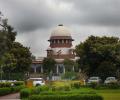
The Supreme Court of India has reprimanded the central government for failing to implement a cashless treatment scheme for road accident victims. The court expressed its concern over the delay in formulating the scheme, which is designed to provide immediate medical care to accident victims within the crucial "golden hour." The court highlighted that despite a statutory provision requiring the scheme's implementation, the government has not taken any action, prompting the court to intervene. The court also criticized the General Insurance Council (GIC) for raising objections to the scheme and delaying its implementation. The court has now directed the government to notify the scheme within a week and has scheduled a hearing on the matter for May 13.

The Supreme Court has expressed its dissatisfaction with the Delhi Police's handling of appeals against acquittals in the 1984 anti-Sikh riots cases. The court emphasized the need for serious and earnest prosecution, not just for the sake of it. This comes in the wake of a public interest litigation filed by a former Shiromani Gurudwara Prabhandak Committee member, seeking justice for the victims of the violence.

The Supreme Court of India has ordered a progressive reduction in the deputation of Indian Police Service (IPS) officers to Central Armed Police Forces (CAPFs) over the next two years, citing concerns over the delayed promotions of cadre officers. The court's decision aims to address the long-standing grievances of CAPF officers who feel their promotional prospects are hampered by the presence of IPS officers in higher ranks. The ruling also mandates a cadre review of the CAPFs to be completed within six months, addressing the issue of stagnation in the service hierarchy. The court's decision acknowledges the valuable contributions of CAPF officers while also recognizing the need to balance their promotional prospects with the operational requirements of the forces.

The Supreme Court of India has criticized the Uttar Pradesh government and Prayagraj Development Authority for the demolition of homes in the city, calling the actions "inhuman and illegal." The court ordered the authority to pay Rs 10 lakh compensation each to the homeowners, stating that the demolitions were carried out in a "high-handed" manner without following due legal process. The petitioners, whose homes were demolished, argued that the state government wrongly believed the land belonged to gangster-politician Atiq Ahmed. The Allahabad High Court had previously rejected their plea challenging the demolition.

Bombay HC stays proposed Metro fare hike till Jan 29.

The Supreme Court of India has ruled that foreign nationals facing criminal charges cannot be allowed to leave the country. The court emphasized the need to ensure the presence of foreigners during criminal proceedings and outlined procedures for enforcing this restriction. The ruling clarifies legal provisions related to foreigners' movements in India, particularly during bail applications.

The Supreme Court of India has made public the asset details of its judges, including Chief Justice Sanjiv Khanna who has Rs 55.75 lakh in a fixed deposit, a three-bedroom DDA flat in south Delhi, and a four-bedroom apartment measuring 2,446 square feet in the Commonwealth Games Village. The court has also uploaded the complete process of appointments to the high courts and the Supreme Court on its website for public awareness.

A bench of Justices Abhay S Oka, Ahsanuddin Amanulllah and Augustine George Masih said the Commission for Air Quality Management in National Capital Region and Adjoining Areas Act of 2021 (CAQM Act) was enacted without creating required machinery for implementing the provision to curb air pollution.

A bench of Justices Abhay S Oka and Pankaj Mithal said the agency cannot cast aspersions on the entire judiciary in West Bengal.

The Supreme Court has dismissed a Public Interest Litigation (PIL) seeking the registration of an FIR over the alleged discovery of burnt wads of cash at the official residence of Delhi High Court judge Yashwant Varma. The court said an in-house inquiry was underway and there would be several options open to the Chief Justice of India after the probe's conclusion.

A bench of Justices Abhay S Oka and Augustine George Masih, however, refused to interfere with the September 26 order of the apex court granting bail to Balaji on a plea filed by one of the complainants seeking its cancellation.
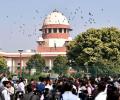
The Supreme Court of India has stayed a Lokpal order that allowed complaints to be filed against a sitting high court judge. The court termed the order "something very, very disturbing" and a concern for the independence of the judiciary. The bench issued notices to the Centre, the Lokpal registrar, and the complainant, directing them to keep the identity of the judge confidential. The court will hear the matter again on March 18.

The Supreme Court of India has ruled that the offence of abetment of suicide should not be invoked mechanically against individuals, emphasizing that the provision should not be used to soothe the feelings of grieving families. The court stressed that the conduct of the accused and the deceased, their interactions, and conversations preceding the death should be examined practically and not divorced from real-life contexts. The judgment came after a plea challenging an order of the Madhya Pradesh High Court that refused to discharge a man from charges under Section 306 of the Indian Penal Code (IPC) related to a suicide case. The Supreme Court emphasized that to prove abetment of suicide, there must be evidence of active instigation or acts facilitating the suicide. In this case, the court found that the appellant's actions, including seeking repayment of a loan, did not constitute instigation to suicide.
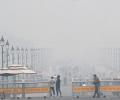
The SC questioned the Delhi government over delay in implementation of stricter anti-pollution measures under GRAP-4, and said it will not allow scaling down of the preventive measures without its prior permission.
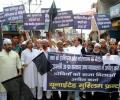
The Supreme Court of India granted bail to eight convicts in the 1987 Hashimpura massacre case. The case involved the killing of 38 people by personnel of the Provincial Armed Constabulary. The court considered the fact that the convicts have been incarcerated for over six years following the Delhi High Court's reversal of their acquittal by the trial court.

A bench of Justices BR Gavai and Abhay S Oka said the governments must ensure that action is taken against erring officials.

The Supreme Court of India will examine the jurisdiction of the Lokpal, India's anti-corruption ombudsman, in entertaining complaints against sitting high court judges. The court is considering a suo motu proceeding initiated over the Lokpal's January 27 order on the issue. The case involves two complaints filed against a sitting additional judge of a high court, alleging that he influenced a judge of the subordinate judiciary and a judge of the same high court set to deal with a suit filed against the complainant by a private company.

The Chief Justice of India (CJI) Sanjiv Khanna has assured bar leaders that he will consider their demand for withdrawal of the collegium's recommendation to transfer Delhi High Court's Justice Yashwant Varma. The decision came after representatives of six bar associations of different high courts met with the CJI and other collegium members. The bar associations are protesting the proposed repatriation of Justice Varma to his parent high court, alleging that the evidence in a fire incident at his residence was tampered with. The bar associations have also raised concerns about the non-registration of an FIR in the incident.
The Supreme Court of India censured the Assam government for keeping persons declared foreigners in detention centers indefinitely and not deporting them. The court questioned the state's explanation for not sending nationality verification forms to the Ministry of External Affairs, stating that detainees should be deported immediately once identified as foreigners. The court directed the Assam government to initiate the deportation process of 63 declared foreign nationals whose nationality was known and file a status report in two weeks. The court also directed the Centre to provide details of those deported and how it plans to deal with detainees whose nationality is unknown.

"Are you waiting for some muhurat," the Supreme Court remarked on Tuesday as it came down heavily on the Assam government for keeping people declared as foreigners in detention centres indefinitely rather than deporting them.
The apex court said that the accused did not misuse his liberty by protesting and expressing his views and also rejected the request of the state government to impose a condition on Sattai to refrain from making scandalous remarks while on bail.
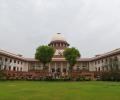
The Supreme Court on Tuesday set aside an order of the Calcutta high court in which it acquitted an accused in a sexual assault case and made 'objectionable' observations advising adolescent girls to 'control sexual urges'.

The apex court was hearing a PIL filed by Tushar Gandhi, the great-grandson of Mahatma Gandhi, seeking speedy investigation in the student slapping case.
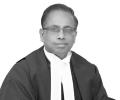
Justice Vishwanathan said he was in "the Common Cause (the NGO which had filed the PIL in coal scam cases). This case was of the ED (Enforcement Directorate), but still...".

The Supreme Court of India expressed concern over the appointment of DMK leader V Senthil Balaji as a minister in the Tamil Nadu government despite pending money laundering cases against him. The court questioned the state government's decision, stating it is "terribly wrong" to appoint a person as a minister while facing legal proceedings. The matter has been adjourned to January 15, 2025.
In 1997, the seven-judge bench ruled that the Centre had the regulatory power over the production of industrial alcohol. The case was referred to the nine-judge bench in 2010.

In a development that may encourage increased investment in commercial real estate, the Supreme Court on Thursday gave the industry relief by permitting input tax credit (ITC) on construction expenses for buildings meant to be leased. "If the construction of a building was essential for carrying out the activity of supplying services, such as renting or giving on lease or other transactions in respect of the building or a part thereof, which are covered by clauses (2) and (5) of Schedule II of the CGST (Central Goods and Services Tax) Act, the building could be held to be a plant," said Justice Abhay S Oka and Justice Sanjay Karol.

Even Ajmal Kasab was given a fair trial in our country, the Supreme Court on Thursday remarked and indicated it may set up a courtroom inside Tihar Jail for the trial of J-K separatist leader Yasin Malik in a kidnapping case.

The Supreme Court verdict on mining royalty case will give a further jolt to the Indian mining industry and will have very large financial implications, as arrears may work out to the tune of more than Rs 1.5 lakh crore to Rs 2 lakh crore, industry players said on Wednesday. The Supreme Court on Wednesday upheld the power of states to levy tax on mineral rights and mineral-bearing land, and allowed them to seek refund of royalty from April 1, 2005 onwards. According to a senior mines ministry official, the verdict will have a very large financial impact on mining, steel, power and coal companies.

A division bench of the Bombay High Court on Monday declined to hear a bunch of petitions challenging the constitutional validity of the beef ban legislation in Maharashtra after one of the judges recused himself from hearing them.

The Bombay high court has posted for final hearing on Wednesday a bunch of petitions challenging the beef ban legislation in Maharashtra.
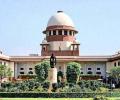
The top court said that retaining the file of a case for five months after demitting office was an act of gross impropriety.

The Supreme Court on Thursday said constitutional courts cannot allow provisions of the Prevention of Money Laundering Act to become instruments in the hands of the Enforcement Directorate to continue incarceration for a long time.

The Supreme Court on Wednesday rapped the Haryana and Punjab governments over non-prosecution of violators found guilty of stubble burning and summoned the state chief secretaries to appear before it on October 23 and submit. an explanation.

A bench of Justices Abhay S Oka and Augustine George Masih, therefore, dismissed a plea of the Enforcement Directorate challenging a high court verdict that quashed the cognisance order of the agency's complaint (chargesheet) against two IAS officers.

A bench of Justices Abhay S Oka and Augustine George Masih referred to newspaper reports mentioning a considerable violation of court orders.
A bench of Justices Abhay S Oka and Augustine George Masih said once a case has been made out for the grant of bail to an accused, the court cannot decline the relief.

Delhi's air quality deteriorated significantly on Monday, with areas like Dwarka, Mundka and Najafgarh recording an AQI of 500, the worst this season. The city's overall AQI reached 491, triggering the implementation of the Graded Response Action Plan (GRAP) Stage-IV restrictions in Delhi-NCR. Doctors warned of health risks, urging people to wear N95 masks and avoid outdoor activities. The Supreme Court questioned the Delhi government on its anti-pollution measures and warned against scaling down preventive measures without its permission. Delhi Chief Minister Atishi accused the BJP-led central government of political maneuvering while neglecting stubble burning in states it governs. Meanwhile, the city enforced stricter pollution control measures, including a ban on truck entry and suspension of construction activities. Air purifier sales surged, reflecting the public's concern over the severe air pollution.

"Is this the job of the court? Why do you file such petitions? the bench said.
